Heavy drinking can affect more than your liver. It can also interfere with how your body gets and uses essential nutrients, including vitamin B12.
Vitamin B12 plays an important role in keeping your nerves healthy, producing red blood cells, and supporting normal brain function. When your body doesn’t get enough, you may experience fatigue, weakness, memory problems, or tingling in your hands and feet.
For people who drink heavily, these symptoms can be particularly concerning. Alcohol can contribute to poor nutrition and may interfere with vitamin B12 absorption. At the same time, symptoms associated with a B12 deficiency can overlap with other effects of heavy drinking.
Understanding the connection can help you recognize potential warning signs, know when to seek medical advice, and make more informed decisions about supplements.
What Does Vitamin B12 Do?
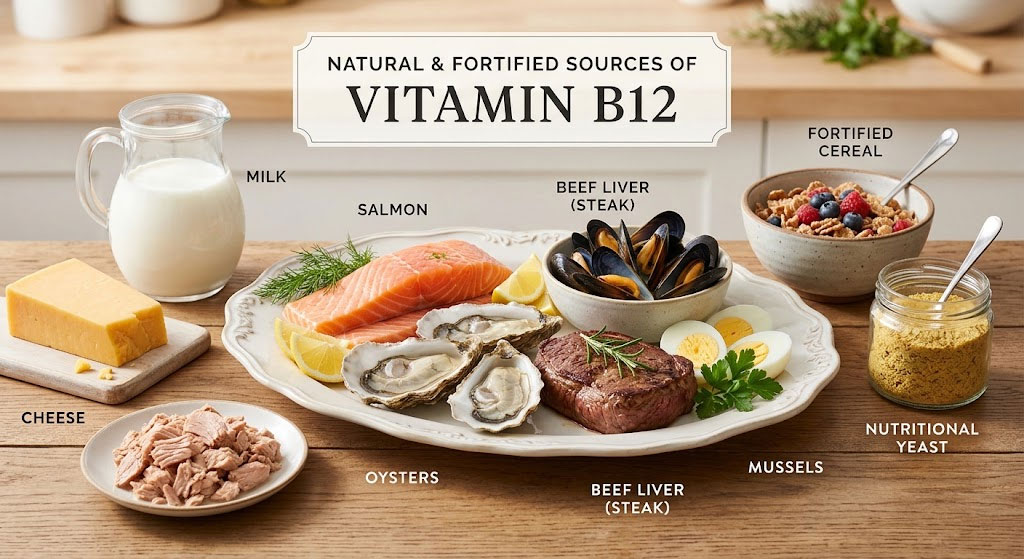
Vitamin B12 is an essential nutrient that your body needs to function properly. It helps maintain healthy nerve cells, supports the production of red blood cells, and helps your body make DNA.
Your body cannot produce B12 on its own, so you need to obtain it through food or supplements.
Good dietary sources include meat, fish, eggs, milk, and other dairy products. Some fortified foods also contain B12, making them useful options for people who eat little or no animal products.
Your body can store B12 for a long time. As a result, a deficiency may develop gradually, sometimes taking years to produce noticeable symptoms.
However, once your levels become too low, the consequences can extend beyond feeling tired. A serious or prolonged deficiency can damage your nervous system and cause problems that may not be completely reversible.
Can Heavy Drinking Cause Vitamin B12 Deficiency?
Yes, heavy drinking can contribute to vitamin B12 deficiency, although the relationship is more complicated than simply drinking alcohol and losing B12.
There are several reasons people who drink heavily may be at greater risk.
1. Alcohol can interfere with B12 absorption
Your body needs to absorb vitamin B12 from food before it can use it.
Excessive alcohol consumption can interfere with this process. Alcohol-related digestive problems may also make it harder for your body to obtain the nutrients it needs.
If you regularly drink heavily, these effects may contribute to nutritional deficiencies over time.
2. Drinking can affect your eating habits
Alcohol can take priority over regular meals, particularly when drinking becomes a daily habit.
Some people eat less, skip meals, or rely on foods that don’t provide enough essential nutrients. Others may struggle to maintain a balanced diet during periods of heavy drinking.
If your diet consistently lacks B12, your body’s stores may eventually become depleted.
3. Long-term heavy drinking can affect your overall nutritional health
Alcohol-related health problems can involve more than one nutrient.
People with alcohol use disorder may experience multiple nutritional deficiencies, depending on their diet, drinking patterns, and general health.
Vitamin B12 is one possible concern, but it is not the only one.
Importantly, not everyone who drinks heavily will develop a B12 deficiency. The risk depends on several factors, including nutritional intake, absorption, existing medical conditions, and the duration and severity of drinking.
If you have been drinking heavily for months or years, it is worth discussing your nutritional health with a healthcare professional, particularly if you have developed unexplained symptoms.
Signs and Symptoms of Vitamin B12 Deficiency
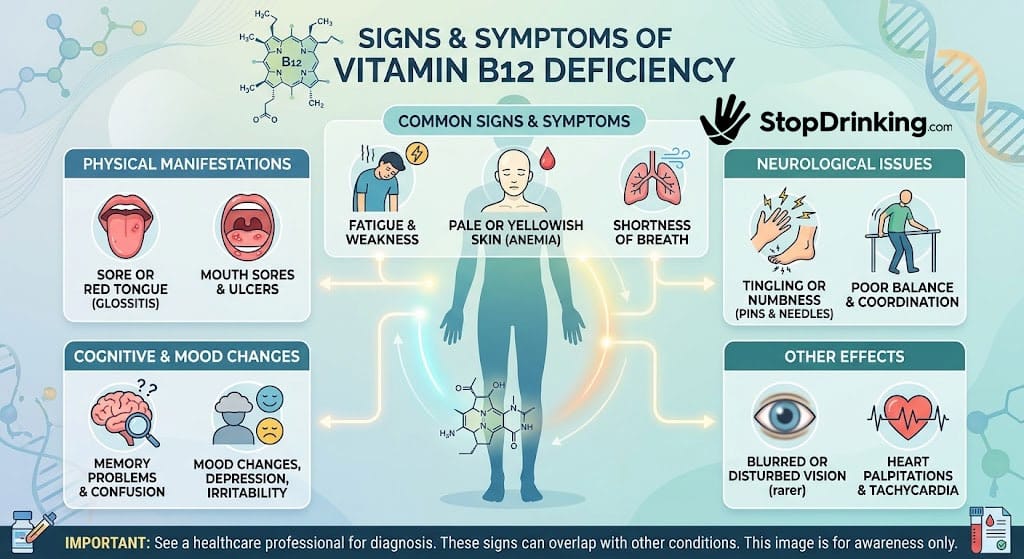
A vitamin B12 deficiency can affect people in different ways. Some develop noticeable symptoms, while others may have low levels before realizing anything is wrong.
The symptoms can also overlap with those caused by alcohol itself, poor sleep, dehydration, and other health conditions.
Possible signs include:
- Persistent fatigue: Feeling unusually tired, weak, or lacking energy, even after resting.
- Difficulty concentrating: Finding it harder to focus, think clearly, or complete everyday tasks.
- Memory problems: Experiencing unusual forgetfulness or difficulty remembering information.
- Numbness or tingling: Feeling pins and needles or reduced sensation in your hands, feet, or legs.
- Balance problems: Feeling unsteady when standing or walking.
- Muscle weakness: Finding everyday physical activities more difficult than usual.
- Mood changes: Experiencing changes in mood or feeling unusually low.
- Pale skin or a sore tongue: Possible signs associated with B12 deficiency and anemia.
- Heart palpitations: Feeling that your heart is racing, pounding, or beating irregularly.
These symptoms do not automatically mean you have a B12 deficiency. They can have many causes, including conditions that need different treatment.
However, persistent or unexplained symptoms deserve attention, particularly if you have a history of heavy drinking.
Can B12 deficiency cause brain fog?

Yes, It can.
Vitamin B12 is important for normal nervous system function. When levels are too low, some people experience problems with concentration, memory, or clear thinking.
For someone who drinks heavily, this can make it difficult to understand what is happening.
Alcohol itself can affect memory and concentration. Poor sleep, inadequate nutrition, and other medical conditions can also contribute to brain fog.
If you continue to experience these problems, don’t assume they are simply the result of drinking or that a B12 supplement will resolve them. A medical assessment can help identify the underlying cause.
Can B12 deficiency cause nerve damage?
Yes. This is one of the most important reasons not to ignore a possible deficiency.
Vitamin B12 helps maintain the nervous system. When a deficiency goes untreated, it can cause neurological problems, including numbness, tingling, changes in sensation, and difficulty with balance.
In some cases, nerve damage can occur even without the anemia commonly associated with B12 deficiency.
Heavy alcohol consumption can also cause nerve damage independently of B12 levels.
This means someone who drinks heavily could have alcohol-related nerve damage, a B12 deficiency, or both.
Taking a supplement without investigating the cause may delay appropriate treatment.
Seek prompt medical attention if you develop new numbness, tingling, or balance problems. New confusion, difficulty walking, or rapidly worsening neurological symptoms warrant urgent medical assessment.
How Much Vitamin B12 Do You Need?
For most adults, the recommended daily intake is approximately 2.4 micrograms (mcg) in the United States.
Recommendations vary slightly between countries. For example, UK guidance generally recommends 1.5 micrograms daily for adults.
These figures represent the amount needed to meet normal nutritional requirements. They are not the same as the doses sometimes used to treat an existing deficiency.
This distinction matters when shopping for supplements.
You may see products containing 500 mcg, 1,000 mcg, or even 5,000 mcg of vitamin B12. These amounts can look surprisingly high compared with the daily requirement.
However, your body absorbs only a fraction of large oral doses. The amount absorbed also depends on how your body processes B12 and whether you have an underlying absorption problem.
High-dose oral B12 is used in some deficiency treatment plans, but more is not automatically better for everyone.
If you drink heavily and suspect you have a deficiency, the appropriate dose depends on your circumstances. A healthcare professional can help determine whether you need supplementation, testing, or a specific treatment plan.
Choosing a Vitamin B12 Supplement: What Should You Look For?
Not all supplements are identical.
Products can differ in their B12 content, formulation, manufacturing standards, and quality controls. Independent testing has also found that some B-vitamin supplements do not contain the amounts stated on their labels.
This doesn’t mean every inexpensive supplement is poor quality or that expensive products are necessarily better.
It does mean you should look beyond the front of the packaging.
1. Check which form of B12 it contains
The most common forms found in supplements include:
- Cyanocobalamin: A widely used and well-studied form of vitamin B12.
- Methylcobalamin: Another commonly available form of B12.
- Adenosylcobalamin: A form also used in some supplements.
You may see claims that one form is dramatically superior to the others. However, current evidence has not established that methylcobalamin is generally more effective than cyanocobalamin for routine supplementation.
Both are legitimate forms of B12. The most appropriate option depends on the product, the reason for supplementation, and individual circumstances.
Don’t assume that a product is better simply because its label uses terms such as active, bioactive, or premium.
2. Look at the actual B12 dose
Check the amount of B12 provided per tablet, capsule, or serving.
A product containing 1,000 mcg is not automatically better than one containing 100 mcg. The right amount depends on whether you are maintaining adequate intake or treating a confirmed deficiency.
Some people with a diagnosed deficiency need higher doses than those used for routine supplementation.
If your deficiency is related to poor absorption, you may need a specific treatment plan rather than simply choosing a stronger product.
3. Look for reliable quality controls
A trustworthy manufacturer should clearly identify the ingredients and amounts in its product.
Where possible, look for independent quality verification or testing that checks whether the product contains what the label claims.
Recognized programs include USP verification and NSF certification, although the relevant certification must apply to the specific product rather than simply the company in general.
Other useful signs include clear manufacturer information, batch details, expiration dates, and transparent quality-control practices.
Be cautious of products promising to cure alcohol-related nerve damage, eliminate brain fog, or restore your energy regardless of the cause of your symptoms.
These are not benefits that a supplement manufacturer can responsibly guarantee.
4. Do you need methylcobalamin, a sublingual tablet, or a liquid?
Vitamin B12 is available as standard tablets, chewable tablets, lozenges, sublingual products, and liquids.
Sublingual products dissolve under the tongue, while liquids may be easier for some people to take.
However, research has not established that sublingual B12 is generally more effective than standard oral supplements.
For most people, the important considerations are the amount of B12, the quality of the product, and whether the formulation is suitable for their needs.
If you have an absorption problem or a confirmed deficiency, speak to a healthcare professional about the most appropriate treatment.
Vitamin B12 supplements worth comparing
The following are established supplement brands that offer B12 products. They are examples to investigate, not a ranking or a guarantee that every product from each manufacturer has been independently verified.
- NOW Foods: Offers several B12 formulations, including cyanocobalamin and methylcobalamin products.
- Solgar: Offers B12 supplements in different strengths and formulations.
- Nature Made: Offers B12 products, including 1,000 mcg formulations in some markets.
You can compare their available products here:
Availability and formulations vary by country. Check the exact product label, serving size, ingredients, and any applicable independent quality verification before purchasing.
We have not independently tested these products or verified the quality of every formulation. Their inclusion should not be interpreted as a medical endorsement.
One final point about supplements: if you think you have a B12 deficiency, consider speaking to a healthcare professional before starting high-dose supplementation. When possible, testing before treatment can help establish whether a deficiency is present and identify the likely cause.
Should You Take Vitamin B12 If You Drink Heavily?
Not necessarily.
Heavy drinking can increase the risk of nutritional problems, but it doesn’t mean every person who drinks needs a B12 supplement.
If you eat a balanced diet, absorb B12 normally, and have no deficiency, additional supplementation may offer little benefit.
However, supplementation may be appropriate if you have inadequate dietary intake, a confirmed deficiency, or a medical condition that affects absorption.
It is particularly worth discussing B12 with your doctor if you have been drinking heavily for a prolonged period and have also been eating poorly.
A healthcare professional can assess your symptoms, review your diet and medical history, and decide whether testing or treatment is appropriate.
Can vitamin B12 give you more energy?
Vitamin B12 is essential for normal energy metabolism and red blood cell production. A deficiency can cause fatigue and weakness.
Correcting a deficiency may help improve symptoms related to it.
However, B12 is not a stimulant, and taking extra B12 has not been shown to improve energy in people who already get enough.
If you are constantly exhausted, don’t automatically assume you need a stronger supplement. The cause could be a deficiency, anemia, a sleep problem, an alcohol-related health condition, or something else that needs attention.
Can you take B12 while still drinking alcohol?
There is no established reason that ordinary oral B12 supplementation must always be avoided simply because someone is drinking alcohol.
However, taking B12 does not protect you against alcohol-related harm or make heavy drinking safer.
If you are drinking heavily, experiencing withdrawal symptoms, or struggling to maintain adequate nutrition, the priority should be getting appropriate medical support.
A supplement cannot compensate for the wider effects of prolonged heavy drinking.
What Happens to Your B12 Levels After You Stop Drinking?
Stopping drinking can be an important step toward improving your overall health and nutritional habits.
However, vitamin B12 recovery is not always immediate, and stopping alcohol does not automatically correct an existing deficiency.
If heavy drinking contributed to inadequate food intake, improving your diet may help restore normal nutritional intake.
If your body cannot absorb B12 properly, you may still need ongoing supplementation or medical treatment.
The same applies if a deficiency has already caused anemia or neurological symptoms. These problems may require specific treatment and follow-up.
How long does it take to recover from B12 deficiency?
There is no single timeline that applies to everyone.
Some symptoms may begin improving within weeks of appropriate treatment, while others can take longer. Recovery depends on the severity and duration of the deficiency, the underlying cause, and the treatment used.
Neurological symptoms can be particularly unpredictable. Some improve with treatment, but prolonged nerve damage may not completely resolve.
If you have been drinking heavily and notice persistent fatigue, memory problems, numbness, or balance difficulties, don’t rely on time alone to fix the problem.
Seek medical advice so that any deficiency or other underlying condition can be identified and treated.
When Should You See a Doctor About Vitamin B12?
If you drink heavily and have concerns about B12, a conversation with your doctor is a sensible starting point.
You don’t need to wait until your symptoms become severe.
Arrange a medical appointment if you experience:
- Persistent fatigue or unexplained weakness.
- Ongoing difficulty concentrating or unusual memory problems.
- Numbness or tingling in your hands or feet.
- Changes in balance or coordination.
- A sore tongue or unexplained mouth symptoms.
- Unexplained palpitations, breathlessness, or pale skin.
- Significant weight loss or prolonged poor nutrition.
These symptoms can have several causes, so it is important not to diagnose yourself based on a checklist.
How is a B12 deficiency diagnosed?
A healthcare professional will usually consider your symptoms, diet, medical history, and risk factors.
A blood test can measure your vitamin B12 level. Depending on the results and your circumstances, additional tests may be needed to clarify whether a deficiency is present and why it has developed.
In some cases, a further blood test called methylmalonic acid, or MMA, can help clarify a borderline B12 result.
Tell your doctor if you have already started taking B12 supplements, because this may affect the interpretation of your results.
If a deficiency is confirmed, treatment may involve oral supplements or injections, depending on the cause, severity, symptoms, and ability to absorb the vitamin.
What about serious symptoms during or after heavy drinking?
Do not assume that significant neurological symptoms are caused by B12 deficiency alone.
Heavy drinking is associated with other potentially serious conditions, including thiamine deficiency and Wernicke encephalopathy.
New confusion, difficulty walking, significant balance problems, or rapidly worsening neurological symptoms require urgent medical assessment.
If you have been drinking heavily and are experiencing severe withdrawal symptoms, seizures, hallucinations, or severe confusion, seek emergency medical help.
B12 supplementation is not a substitute for urgent treatment.
The Bottom Line
Heavy drinking can contribute to vitamin B12 deficiency through its effects on nutrition and, in some circumstances, absorption.
A deficiency can cause fatigue, weakness, cognitive symptoms, anemia, and potentially serious nerve problems. Some of these symptoms overlap with the effects of alcohol itself, which makes it important to identify the actual cause rather than simply guessing.
If you drink heavily, particularly if you have been eating poorly or have developed unexplained symptoms, consider discussing your B12 levels with a healthcare professional.
If you decide to purchase a supplement, look for a clearly labeled product from a reputable manufacturer and pay attention to the actual B12 content rather than marketing claims. High doses are sometimes used to treat deficiency, but the right treatment depends on the individual.
Most importantly, remember that vitamin B12 can help correct a deficiency, but it cannot undo every effect of heavy drinking or make continued drinking safe.
Understanding the risks and seeking appropriate care can help you make better-informed decisions about your health, whether you are still drinking, thinking about stopping, or already working toward recovery.
Frequently Asked Questions
Does alcohol deplete vitamin B12?
Heavy alcohol consumption can contribute to B12 deficiency by interfering with nutrition and potentially affecting absorption. However, not everyone who drinks heavily develops a deficiency, and other causes should also be considered.
What are the symptoms of low B12 in heavy drinkers?
Possible symptoms include fatigue, weakness, memory or concentration problems, numbness, tingling, and balance difficulties. These symptoms can also have other causes, including alcohol-related health problems.
What is the recommended daily amount of B12?
The recommended intake for adults is approximately 2.4 mcg daily in the United States. Treatment doses can be much higher when a deficiency is present, depending on the cause and the treatment plan.
Is methylcobalamin better than cyanocobalamin?
Current evidence has not established that methylcobalamin is generally superior to cyanocobalamin for routine supplementation. Both are used in B12 products.
Can B12 reverse nerve damage caused by alcohol?
B12 treatment may improve neurological symptoms caused by a B12 deficiency. However, alcohol can damage nerves independently of B12 levels, and that damage may not be completely reversible. Medical assessment is important to determine the likely cause.
Should everyone who quits drinking take vitamin B12?
No. Some people may benefit from supplementation, particularly if they have a deficiency or difficulty absorbing B12. Others may get enough from their diet. Individual risk factors and symptoms should guide the decision.
Can B12 supplements help with fatigue after quitting alcohol?
They may help if a B12 deficiency is contributing to the fatigue. If your B12 levels are already adequate, extra supplementation may not improve your energy. Persistent fatigue deserves medical assessment.
Can you have B12 deficiency without anemia?
Yes. Neurological symptoms can occur even when a person does not have the anemia commonly associated with B12 deficiency. The absence of anemia does not rule out a deficiency.
Sources and Further Reading
The following medical and scientific resources provide further information about vitamin B12, deficiency symptoms, testing, treatment, and supplement quality.
- National Institutes of Health, Office of Dietary Supplements: Vitamin B12: Fact Sheet for Consumers
Information about B12’s role in the body, recommended intake, dietary sources, supplements, and deficiency symptoms. - National Institutes of Health, Office of Dietary Supplements: Vitamin B12: Health Professional Fact Sheet
More detailed information about B12 absorption, deficiency, supplementation, and treatment. - National Heart, Lung, and Blood Institute: Vitamin B12-Deficiency Anemia
An overview of B12 deficiency, its causes, and its effects on health. - National Institute for Health and Care Excellence (NICE): Vitamin B12 Deficiency in Over 16s: Diagnosis and Management
Clinical guidance covering diagnosis, testing, and treatment options. - National Institutes of Health, Office of Dietary Supplements: Thiamin: Health Professional Fact Sheet
Information about vitamin B1 and why thiamine deficiency is an important separate concern in people with alcohol dependence.
Medical disclaimer: This article is for educational purposes and is not a substitute for individual medical advice, diagnosis, or treatment. If you are concerned about alcohol use, nutritional deficiencies, or persistent symptoms, speak with a qualified healthcare professional.